
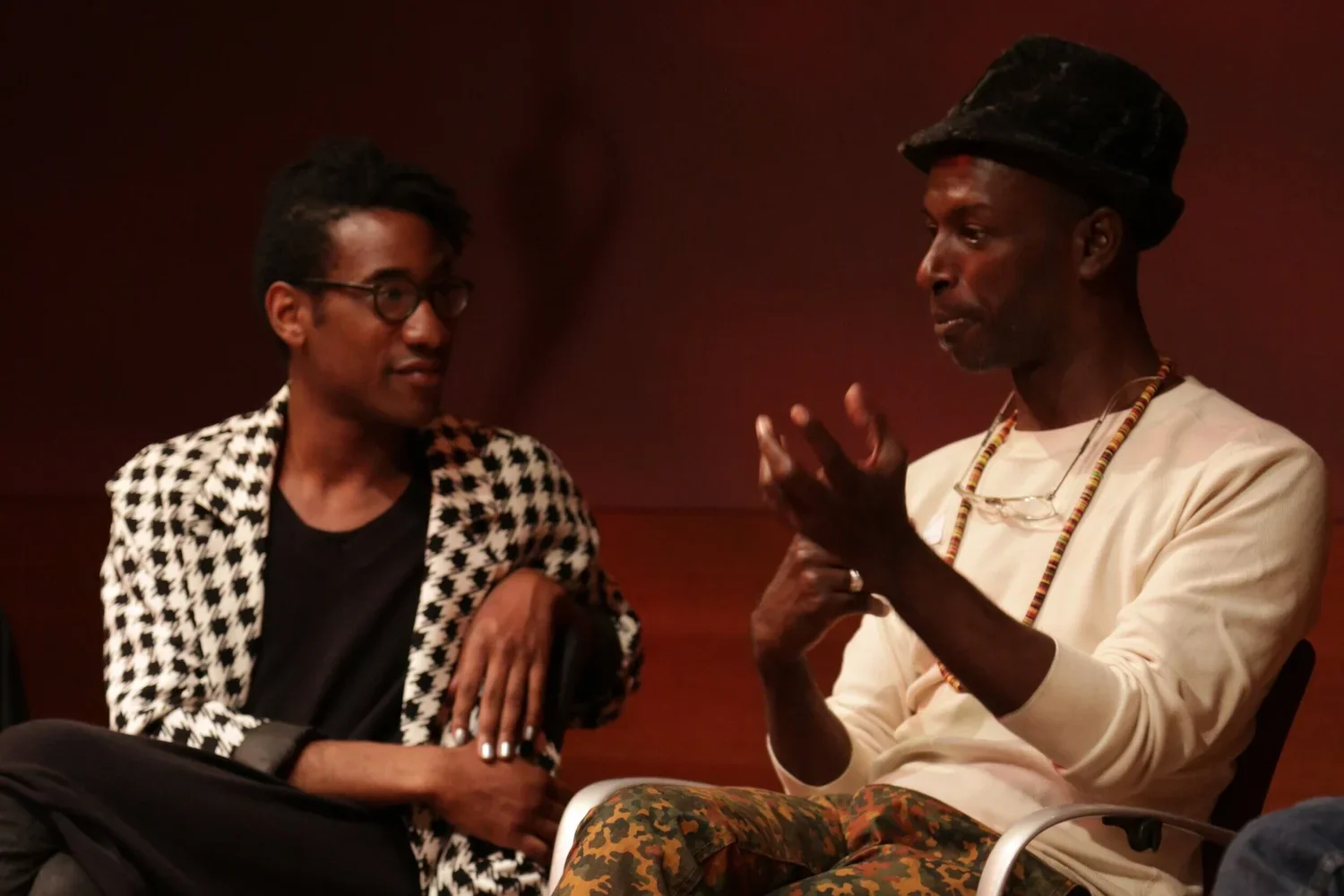
We are excited to share these tips and takeaways from our 2026 Queer|Art Mock Panels!
The aim of our mock panel workshop series is to help our community of artists sharpen their skills in submitting applications and project proposals by going through that process in a trial environment. Artists submit materials as if they were applying for an opportunity (a grant, a residency, etc.) and get 10 minutes of dedicated feedback on their submission.
Queer|Art Mock Panels are inspired by and modeled on the “mock panel” format developed by LJ Roberts at the New School, and have been organized into four different creative fields (Literature, Performance, Film, and Visual Art). Each panel lasted approximately 90 minutes. Panelists reviewed statements, CVs, and work samples for 8 minutes, with 2 minutes allotted to each “applicant” afterwards to ask questions, all taking place live over Zoom.
This year, we were joined by an all-star lineup of arts and cultural workers. The panelists included: Isabella Kapur & Kenny Shiloh Russell (Visual Art), KB Brookins & Ezra Kupor (Literature), Miranda Haymon & Yara Travieso (Performance), and Arno Mokros & Joenique C. Rose (Film).
While sessions are not recorded, we’ve assembled some of the most relevant pieces of advice from our panelists below:
Treat Your Entire Application Like a Narrative
Panelists returned again and again to the idea that an application should be a single story told across several forms, not a set of disconnected prompts to fill out.
The bio, the statement, the CV, and the work samples should all point back toward one coherent sense of who you are and what your work is doing. When a detail from the bio (say, an element of your practice or a second creative discipline) never resurfaces anywhere else in the application, panelists noticed the gap and wanted to know why it mattered enough to mention but not enough to develop.
Look at your finished application as a whole before submitting it, not just section by section, and ask: does everything I've included add up to one clear portrait, or does it read like four separate documents that happen to share a name?
Panels are reading quickly, comparatively, and often without shared context with you. The artists whose applications drew the most praise weren't necessarily doing more, but often they were making it easier for a reader to understand at a glance, who they are, what they make, and where they're going.
For artists working across multiple disciplines, identify the common thread across all work. Show how the same core concerns appear in different mediums and do your best to maintain a recognizable artistic identity. If one of your disciplines is more developed than the others, be sure to explain how your work in that discipline informs your work in the others. As Miranda Haymon put it, “Don't have five dull knives. Have one sharp knife that sharpens the others.”
Make Every Application Component Do Its Own Job
Rather than repeating the same information:
The bio should establish who you are.
The artist statement should communicate your artistic concerns.
The proposal (if applicable) should explain the specific project.
The work sample should demonstrate your craft.
The CV should provide context, not tell the same story again.
Each document should add something new. When bios ran long, the culprit was almost always the same: a laundry list of past exhibitions, grants, and residencies. The advice here was consistent: choose two or three of the most relevant or most recent highlights rather than naming everything. Prestige from years ago is worth less to a reviewer than a clear sense of what you're doing right now, and where that work is going next. Save the exhaustive record for your CV, where it belongs.
The bio is not just a list of accomplishments. A good bio should establish your literary practice, provide relevant publishing or artistic context, and reflect your current trajectory. Include accomplishments that support your application, but avoid turning the bio into an exhaustive résumé.
Organize your CV for readability. The panelists noted that reviewers often skim CVs quickly. Helpful practices include clear section headings, consistent formatting, prioritizing the most relevant accomplishments, and removing outdated or less meaningful entries as your career develops. A clean, easy-to-read CV makes a stronger impression than an overly lengthy one.
Use your word counts on what isn’t already obvious. Work sample descriptions are often capped tightly, and panelists were direct that this space shouldn't be wasted restating information already available elsewhere. Instead, use that limited space to do something the reader can't get anywhere else: additional context, the specific form or structure at play, or what makes this particular sample representative of the larger project. If two sentences can become one without losing meaning, combine them. Every word saved is space for something more useful.
Good Applications Remove Obstacles
Panelists returned again and again to the importance of making your application as easy as possible for reviewers to read.
This isn’t about reducing the complexity of your practice; this is about formatting and assembling all of the elements of your application in a way that ensures reviewers spend all their energy actually evaluating your work.
Here’s some examples:
Small inconsistencies repeatedly distracted reviewers.
Examples included: inconsistent capitalization or italics, awkward spacing, titles formatted differently throughout, or documents longer than the page limit.
Panelists emphasized that these comments weren't about making applications look perfect. They’re about making it as easy as possible for the panelists to follow what you're saying, without getting distracted.
Make navigation as simple as possible
Panelists repeatedly praised applications that were formatted to be easy to follow.
For example, when evaluating applications that included video or film, panelists emphasized the importance of including cues and timestamps so that it is as clear as possible which section of the work should be viewed.
When looking at work samples, panelists were impressed with applications that formatted their work sample list neatly and clearly, with samples sequenced in the same order as their descriptions so works were easily identifiable.
As one panelist put it, a well-ordered application means the reviewer doesn't have to think about navigation at all; they can just think about the work.
Say the most important thing first.
Reviewers read a lot of applications, often in a short window of time, and details start to blur together. Both panelists emphasized that a bio's opening should hit the reader immediately with the essentials: what materials you work in, what themes define your practice, what makes your work distinct. Don't save the good stuff for the end.
This also means word count is not a target to hit — it's a ceiling. Neither panelist was bothered by a bio that came in well under the maximum. If anything, a concise bio that says exactly what it needs to say reads as more confident than one that pads itself out to fill the space.
Clarity and Specificity Are Crucial
Clear writing demonstrates clear thinking.
One of the most common critiques involved writing that became overly dense or abstract. Panelists consistently preferred writing that was concise, direct, specific, and readable over writing that attempted to sound academic or theoretical. Rather than trying to sound "smart," focus on sounding confident, intentional, and precise. For multiple applicants, reviewers suggested making statements "a little bit more digestible" by breaking long sentences apart.
Reviewers should never have to decode what you’re trying to say.
Avoid unexplained metaphors, open-ended rhetorical questions, and large conceptual statements without context. The panelists appreciated poetic language but emphasized that poetry should not obscure meaning. Introduce complex ideas gradually, and pair poetic language with concrete examples.
The same logic applies to any specialized vocabulary in your statement. Terms that feel self-evident within your own practice — niche theoretical frameworks, subculture-specific language — may not translate to someone reading your application cold. If a concept is central to your work, it's worth taking a sentence to make it legible to a reader who doesn't share your reference points. If you have a rare or self-coined word/phrase you use to describe your practice, define it directly. Panels are not always made up of specialists in your particular area.
Be specific and concrete wherever you can.
In artist statements and project proposals, panelists responded well to specificity. Abstract language about wanting to "take bigger risks" or "explore new territory" is pleasant to read but hard for a panel to act on. What helped applications stand out was naming tangible outcomes: what would this funding actually let you make, buy, or do? What are the immediate next steps you want to take in the evolution of your practice or project?
Panels are often making comparative decisions about who receives limited opportunity, and concrete goals are simply easier to evaluate and champion.
Clarity also looks like presenting important information as plainly as possible. Reviewers shouldn't have to:
guess what medium you're working in
figure out whether your project is narrative or documentary
decipher complicated writing
hunt through your CV
wonder why you included a work sample
interpret unclear budget categories
Show Your Path Forward
Reviewers want to know where you’re headed, not just where you’ve been.
One of the more specific pieces of feedback concerned the age of work samples. Older samples aren't disqualifying, but panelists consistently said that recent work gives them a much stronger sense of an artist's current trajectory and what you're pushing toward, not just what you've already resolved. If you're applying for support to develop new work, samples that show your most recent thinking make that trajectory visible in a way older, more settled pieces sometimes can't.
“Don’t rest on your laurels.” Panelists specifically cautioned against leaning entirely on past accomplishments when the application is also meant to generate excitement about what's next. If your sample is drawn from an in-progress project, the description should be honest about that: this is early-stage work that you hope to develop further.
Where possible, look for an arc across the pieces you submit. Even a small set of samples can show movement, whether that's a narrative progression, a shift in form, or a widening scope. Panelists responded well when a small set of samples still managed to feel like a complete, cohesive experience rather than a random sampling.
Leave reviewers wanting to see more. The strongest applications create curiosity, and they leave reviewers excited to encounter the work itself. The application’s job is to convince someone that this artist or project is worth investing into, and the standouts are the ones that help reviewers imagine the future artistic progress that they are investing in.
Revise, Revise, Revise
Often, artists reuse materials from past applications when submitting new ones. Be sure to update your CVs, bios, and work samples to include the most recent information and the most relevant information for the specific application at hand. Panelists repeated that there is no universal application. The same artist may submit entirely different applications to different opportunities without changing the underlying practice.
Panelists also emphasized that application writing deserves as much revision as creative work. They encouraged applicants to read materials aloud, share drafts with trusted readers, cut repetition, and define language until every paragraph has a clear purpose.
Rejection is part of the process! Applications improve through multiple drafts, and applying is a skill like any other that improves with practice.
We wish you the best of luck!